
Precision manufacturers today are under pressure to produce more part varieties, in smaller batches, with tighter tolerances—all on the same equipment. This is the reality of high-mix, low-volume (HMLV) manufacturing, and it is becoming the norm across industries like automotive, aerospace, and medical device production.
For grinding operations, HMLV environments create a specific set of challenges. Frequent part changeovers eat into productive time. Manual processes introduce variability. Labor shortages make it harder to sustain consistent output. And older machines—however mechanically capable—often lack the flexibility to keep up. Custom grinder automation solutions address these challenges directly, offering a cost-effective way to modernize existing equipment without replacing it.
Why High-Mix Manufacturing Creates Unique Grinding Challenges
High-mix manufacturing means producing a wide variety of parts, often in small batches, on shared equipment. When a new part family enters the queue, the grinding setup may need to change; wheel dressing parameters, workholding configurations, feed rates, and tolerances may all need to be adjusted or re-established. In a low-mix environment, this is manageable. In a high-mix environment, it becomes a significant drag on productivity.
The cumulative impact is real: longer setup times, higher scrap rates, inconsistent surface finishes, and increased operator workload. When production relies heavily on individual skill and manual adjustment, output becomes unpredictable. And as part complexity increases, so does the risk of quality escapes.
Where Traditional Grinding Systems Fall Short
Many manufacturers are still running legacy grinding machines that were designed for high-volume, low-variety production. These machines can still hold tolerances—but they weren’t built for the pace of change that high-mix manufacturing demands.
The limitations become apparent quickly:
- Manual part loading and unloading ties throughput to operator availability.
- Setup and changeover times reduce the percentage of time the machine is actually grinding.
- Older controls may lack convenient program storage and recall for different part setups, meaning changeovers can require more manual intervention.
- Without in-process gauging, operators may need to perform manual inspections during production, slowing the process and potentially allowing deviations to go undetected between checks.
- Higher scrap and rework costs accumulate over time, raising the total cost of ownership.
Scaling production under these conditions is difficult. And in competitive precision markets, “difficult” often means “unaffordable.”
Key Features of Custom Grinder Automation Solutions
Unlike generic automation packages, custom grinder automation is engineered around the specific requirements of your part mix, machine type, and production environment. The result is a system that works the way your floor actually operates, not the way a catalog assumes it does.
Typical features of a well-designed automated grinding system for high-mix production include the following:
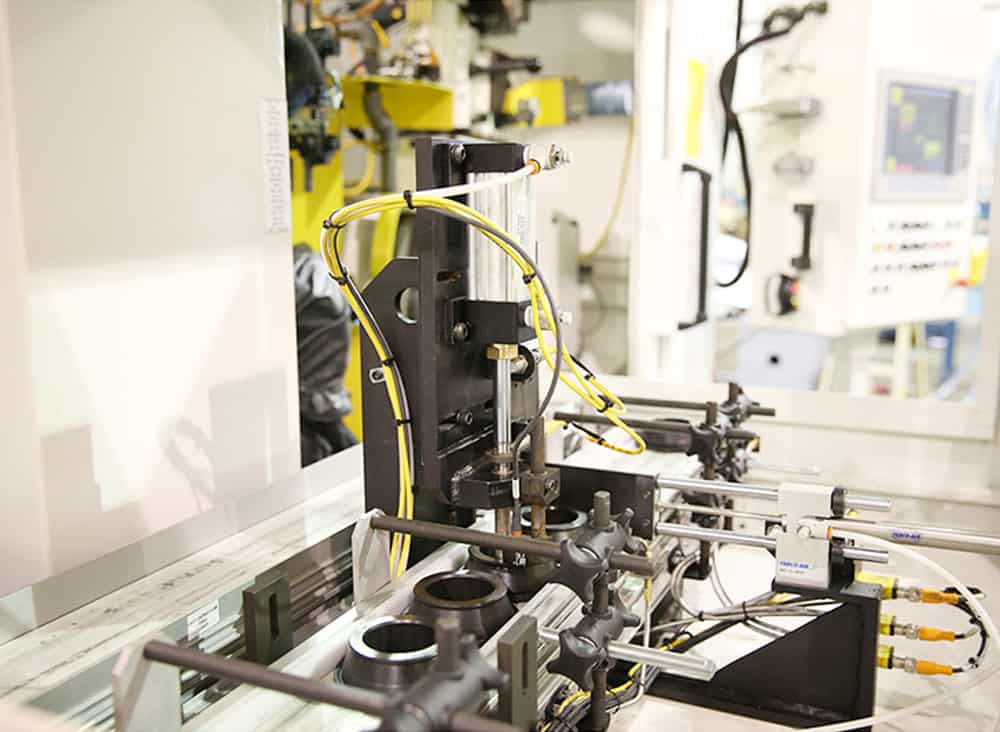
- Robotic part loading and unloading: Gantry systems, robots, vibratory bowl feeders, and conveyors handle parts consistently and without fatigue, reducing cycle times and eliminating handling errors.
- Automatic part changeovers: Programmable setups allow faster transitions between part families with minimal manual intervention.
- CNC control upgrades: Modern controls are among the most impactful grinder upgrades, replacing outdated systems while enabling stored programs, improved repeatability, and data connectivity.
- In-process gauging: Real-time measurement helps keep parts within tolerance throughout the grind cycle, allowing corrective action before significant quantities of scrap are produced.
- Flexible tooling and workholding: Accommodates varied part geometries without requiring major retooling between runs.
- Smart process monitoring: Integrated sensors provide process feedback that enables proactive adjustments and can support condition monitoring and predictive maintenance.
Grinder Retrofitting and Remanufacturing: Modernizing What You Already Own
One of the most practical benefits of retrofitting is that it extends the value of equipment you already own. Rather than investing in a new machine, manufacturers can target specific limitations and address them directly.
At GCH Machinery, our grinder retrofitting services focus on controls, automation, electronics, and motion systems upgrades. A CNC grinder retrofit, for example, can replace an outdated control system with a modern platform, enabling stored programs for multiple part setups, improved accuracy, and connectivity for data reporting. Industrial automation for grinding can also add robotic loading to a manual grinder, reducing operator dependency and increasing throughput without requiring a full machine overhaul.
Grinder remanufacturing goes further. It can involve complete machine restoration plus modernization—rebuilding the machine mechanically while upgrading controls and, where appropriate, integrating automation. The result is an efficient legacy grinder modernization, bringing older equipment up to current production standards, with the connectivity and controls needed to support modern manufacturing and Industry 4.0 initiatives.
Both approaches deliver meaningful improvements in accuracy, repeatability, and production capacity while reducing maintenance requirements over time.
Why Choose GCH Machinery for Grinder Automation and Remanufacturing?
For more than 60 years, GCH Machinery has provided turnkey grinding solutions to manufacturers worldwide. Our engineering team designs, manufactures, and integrates automated grinding systems tailored to specific production requirements, from straightforward load/unload modules to sophisticated multi-function cells. With a long track record of successful installations globally, GCH brings extensive experience to every project.
GCH also provides in-house metrology and worldwide field service support. Our on-site laboratory is equipped with Carl Zeiss precision instruments, including a coordinate measuring machine, form measurement equipment, and surface finish inspection systems. We design to tolerances as tight as 0.5 μm and develop solutions around each customer’s application—not a cookie-cutter package. Whether the project calls for targeted grinder upgrades, a CNC grinder retrofit, custom automation, or complete grinder remanufacturing, GCH Machinery can deliver a solution tailored to the equipment and production requirements.
The Right Automation Partner Makes the Difference
High-mix manufacturing isn’t going away; if anything, the pressure to handle greater part variety with the same equipment will only increase. Manual grinding systems and legacy setups without automation will continue to fall short on throughput, consistency, and flexibility.
Custom grinder automation solutions—whether through targeted retrofitting or full remanufacturing—offer a proven, cost-effective path forward. They reduce changeover time, improve precision, lower scrap, and free operators to focus on higher-value work.
If your grinding operation is struggling to keep pace with high-mix demands, GCH Machinery can help. Contact us today to discuss a custom automation solution designed for your production needs.