
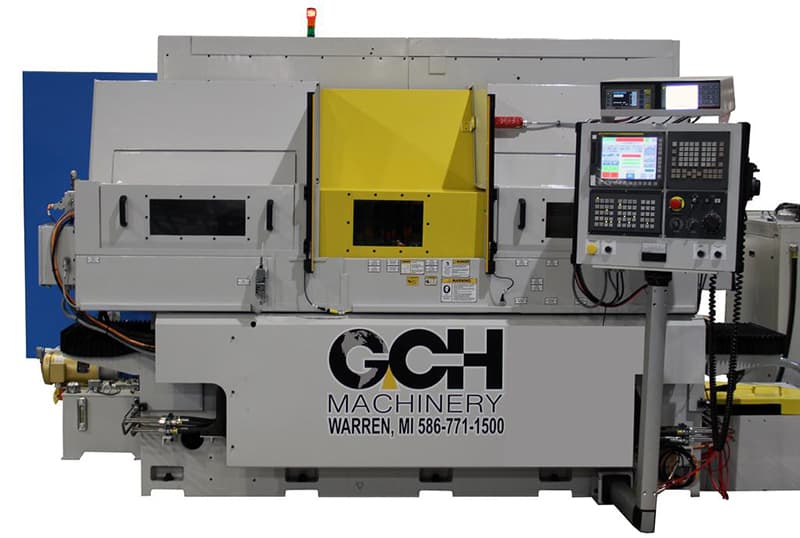
Rising scrap rates, inconsistent surface finish, increasing downtime, and maintenance costs that seem to climb every quarter—these are the signs that a Toyoda grinder is reaching the limits of its current condition. Replacing it with a new machine is expensive, disruptive, and often unnecessary.
A fully remanufactured Toyoda grinder from GCH Machinery delivers like-new or better-than-new performance at a fraction of the cost—and the reason goes much deeper than new electronics or fresh paint. It starts with hand-scraped ways and rebuilt spindles: the foundational work that restores the machine’s geometry, lubrication, and rotational accuracy from the ground up.
Why Do Toyoda Grinders Lose Performance Over Time?
- Spindle and bearing wear: As spindle bearings accumulate hours, they develop play and lose their ability to maintain tight runout tolerances. The result is vibration, chatter, and surface finish inconsistency.
- Way and slide wear without oil film: As sliding surfaces wear and lose their oil-retaining characteristics, stick-slip motion develops—the source of micro-vibration and positional error that shows up in surface finish and dimensional accuracy.
- Guideway and slide wear: The precision linear motion systems wear with use, causing the machine to lose its ability to hold geometry and dimensional tolerances.
- Misalignment: Accumulated wear causes the machine’s geometry to drift. Axes that were once perpendicular or parallel gradually diverge, producing taper, out-of-roundness, and dimensional errors that grow worse over time.
- Outdated CNC and control systems: Older Toyoda controls lack the processing speed, feedback resolution, and automation capabilities of modern systems, and become increasingly difficult to support.
- Aging electrical and hydraulic components: Solenoids, servo drives, hydraulic valves, and electrical systems all degrade with age, introducing inconsistency and failure risk.
What Is Toyoda Grinder Remanufacturing?
Remanufacturing is a complete restoration of your Toyoda grinding machine to like-new or better-than-new condition. It is not a repair, and it is not the same as retrofitting.Service Type | What It Involves |
Repair | Fixes a specific failure or symptom. Addresses the immediate problem but does not restore overall machine condition, way geometry, or spindle accuracy. |
Retrofitting | Targeted upgrades to specific systems—typically CNC controls, coolant, or automation. Improves capability without a full mechanical rebuild or way scraping. |
Remanufacturing | Complete teardown to the base casting. All ways, slides, and mating surfaces are hand-scraped and flaked for precision alignment and oil retention. Spindles are fully rebuilt. Worn components are replaced. The machine is restored to its full original specification—or beyond. |
Key Signs Your Toyoda Grinder Needs Remanufacturing
- Frequent machine breakdowns that disrupt production schedules
- Inconsistent part quality—surface finish or dimensions that vary from shift to shift
- Rising scrap and rework rates attributed to the machine rather than tooling or process
- Axis movement that feels “jerky” or inconsistent—a sign of stick-slip from degraded way surfaces
- Excessive vibration or chatter that wasn’t present when the machine was newer
- Difficulty holding tolerances the machine once achieved routinely
- Maintenance costs that keep climbing with repairs that solve one problem only to reveal the next
Rule of Thumb
When annual maintenance costs approach 15–20% of the machine’s replacement value, remanufacturing almost always delivers a better return on investment than continued repair.How GCH’s Remanufacturing Services Restore Your Toyoda Grinder
GCH’s remanufacturing process is comprehensive—every system is addressed, nothing is patched. The two most critical elements are the ones that determine whether a remanufactured machine actually performs like new: the hand scraping of all mating surfaces and the complete rebuilding of the spindle assemblies.Hand Scraping of Slides, Ways, and Mating Surfaces
One of the most important—and least understood—aspects of GCH’s remanufacturing process is hand scraping. In an era of CNC machining and automated surface finishing, hand scraping remains the gold standard for restoring the precision geometry and lubrication characteristics that grinding machines demand. GCH craftsmen hand scrape and flake every critical mating surface on every machine we remanufacture.The process works by applying a thin coat of engineer’s blue (Prussian blue in an oil base) to a precision reference surface. When the mating component is laid against it, the blue transfers only to the high spots on the workpiece. The scraper removes those high spots, and the process repeats—pass by pass—until the contact pattern achieves the precise, evenly distributed bearing area that precision grinding demands. Fine scraping produces 24–36 contact points per square inch, a level of accuracy no grinding or milling operation can reliably achieve on large castings.
Why Hand Scraping Cannot Be Replaced by Machine Grinding
Large grinding machine castings cannot always be fixtured in a surface grinder—hand scraping is the only method that can true mating surfaces in place. Machine grinding produces a uniform surface that actually resists oil film formation. Hand scraping creates the precise combination of high bearing points and oil retention pockets that precision sliding surfaces require. Hand scraping corrects the specific, irregular wear patterns of each individual machine—something automated processes cannot replicate.Oil Retention and the Flaking Process
Precision grinding machines require a continuous, uninterrupted oil film between all sliding surfaces—the worktable, cross slide, wheel head, and infeed mechanisms. Without it, the stick-slip phenomenon occurs: surfaces momentarily bind together, then lurch forward, introducing micro-vibration and positioning errors that show up directly in part surface finish and dimensional accuracy.GCH addresses this through flaking—the decorative half-moon pattern visible on properly remanufactured grinding machine ways. Flaking creates a network of shallow oil reservoirs across the surface. These pockets trap and hold lubricating oil under surface tension, maintaining the oil film across the entire bearing area throughout the machine’s motion. The result is smooth, consistent, vibration-free axis movement—the foundation of repeatable part quality.
The flaking pattern is not merely cosmetic. It is evidence that a craftsman has done the work correctly. When you see a properly flaked way surface on a GCH-remanufactured machine, you are looking at the reason that machine will hold tolerance shift after shift, year after year.
Spindle Rebuilding: Precision Bearings and Hydrostatic Systems
The spindle is the heart of any grinding machine. Everything—surface finish, dimensional accuracy, chatter behavior, and long-term consistency—originates at the spindle. GCH’s remanufacturing process treats spindle rebuilding with the same level of care and technical rigor as the rest of the machine, with full capability to rebuild both conventional anti-friction bearing spindles and the more demanding hydrostatic bearing systems found on high-precision grinders.Anti-Friction Bearing Spindle Rebuilding
For wheel head and work head spindles equipped with precision roller or ball bearings, GCH’s rebuilding process begins with complete disassembly and dimensional inspection of every component—housing bores, shaft journals, shoulders, and faces—checked to tolerances down to half a micron. All housing bores and shaft surfaces are restored to better than OEM tolerances.New ABEC 7 or higher precision bearings—equal to or exceeding original OEM specification—are installed and pre-loaded to the correct specification for the machine’s application. Dynamic balancing of all rotating components is performed on ultra-precision balancing equipment before assembly. After final assembly, every spindle is run for a minimum of eight hours on dedicated test stands, with vibration analysis, temperature monitoring, and runout verification performed at multiple speeds. The spindle does not leave GCH until it meets or exceeds new OEM specifications. A detailed test report and balance analysis ships with every rebuilt spindle.
Hydrostatic Spindle Rebuilding
Hydrostatic and hydrodynamic spindles are found on the highest-precision grinding machines—OD grinders, centerless wheel heads, and other applications where frictionless operation and extreme rotational accuracy are required. These spindles use a pressurized oil film rather than rolling elements to support the shaft, achieving near-zero runout and exceptional vibration damping that anti-friction bearings cannot match.When a hydrostatic spindle fails, the bearing surfaces and shaft mating surfaces are typically damaged together. Restoration requires precision grinding of both surfaces and meticulous matching of the clearance between them—a gap measured in microns that must be precisely aligned to restore proper hydrodynamic performance. This is exacting work that requires specialized equipment and years of experience. GCH’s spindle specialists have that experience across the full range of hydrostatic grinding spindle types, including wheel head spindles, work head spindles, and centerless wheel spindles.
Critical to any hydrostatic spindle repair is thorough cleaning and flushing of the machine’s entire oil lubrication system. Metallic contamination from a failed spindle will recontaminate a newly rebuilt one. GCH addresses this systematically as part of every hydrostatic spindle remanufacturing project.
GCH Spindle Rebuilding: What Every Rebuilt Spindle Includes
- Complete disassembly, chemical cleaning, and dimensional inspection to sub-micron tolerances
- Restoration of all housing bores, shaft journals, and bearing seats to better than OEM specification
- New ABEC 7 or higher precision bearings (anti-friction) or precision-matched bearing surfaces (hydrostatic)
- Dynamic balancing of all rotating components on ultra-precision equipment
- Minimum 8-hour test run with vibration analysis, temperature monitoring, and runout verification
- Detailed test report and balance analysis shipped with every spindle
CNC and Control System Modernization
GCH installs modern Siemens CNC systems with full-color HMI displays, replacing aging controls that are increasingly difficult to support. New servo drives, motion control systems, and automation-ready architecture give your remanufactured Toyoda capabilities it never had originally. Complete AutoCAD schematics—electrical, hydraulic, and pneumatic—are provided with every machine.Replacing Worn Mechanical Components
Ball screws, linear guides, bearings, solenoids, and hydraulic components are replaced with new or OEM-equivalent parts. New auto-lubrication controls, steel lines, and precision lube blocks replace worn systems that have been struggling to protect critical bearing surfaces.Upgrading Coolant and Filtration Systems
High-pressure, precision-directed coolant delivery and modern filtration ensure the grinding zone stays clean and thermally stable, eliminating the burn marks, microcracks, and premature way wear that poor cooling produces.Industries That Benefit from Toyoda Grinder Remanufacturing
- Automotive manufacturing: Crankshafts, camshafts, transmission shafts, and bearing races demand consistent diameter tolerances and surface finish across high-volume production runs.
- Oil and gas: Valve bodies, pump shafts, and precision oilfield components require tight tolerances and superior surface finish for reliable sealing and corrosion resistance.
- Aerospace: High-tolerance components—e.g., turbine shafts, landing gear, actuator bodies—require grinding accuracy that only a properly remanufactured machine can deliver.
- Heavy equipment manufacturing: Drivetrain and hydraulic components that must perform reliably in demanding field conditions benefit from Toyoda grinder remanufacturing.
Why Choose GCH Machinery for Toyoda Grinder Remanufacturing
Proven at ScaleA single global automotive manufacturer trusted GCH Machinery with more than 50 Toyoda grinders for remanufacturing. That kind of repeat business is only earned through consistent, verifiable results—machines that hold tolerance, shift after shift, because the ways are properly scraped, the spindles are properly rebuilt, and every system has been restored to specification.
GCH Machinery brings over 65 years of experience, a 400,000 square foot facility in Warren, Michigan, and more than 150 combined years of grinding application expertise to every Toyoda remanufacturing project. We work on all Toyoda models and handle the complete scope in-house—mechanical, electrical, CNC, spindle, and automation—with a single point of accountability. Every remanufactured machine is validated against your actual production parts and backed by a full one-year warranty.