
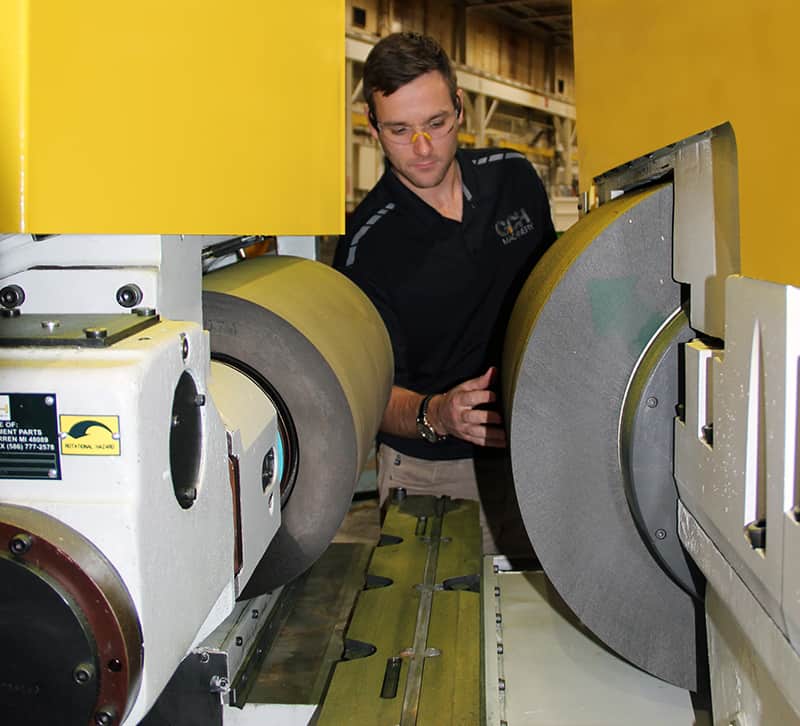
Here’s the real-world difference, using universal tool & cutter grinders and cylindrical universal grinders as concrete examples.
1. Depth of Disassembly
Repair Shop: Typical job: pull the wheelhead, replace spindle bearings, lap the spindle taper, reinstall, and get it running again. They may re-scrape the wheelhead ways if they’re good, but the rest of the machine usually stays together. Time on site or in shop: 1–4 weeks.Remanufacturing: The machine is completely torn down to the casting. Every nut, bolt, and pipe is removed. Castings are cleaned, inspected for cracks, and stress-relieved if needed. All ways (hand-scraped or Turcite-lined) are re- qualified to factory flatness and parallelism—usually to under 50 millionths (0.00005″) over the full travel on a high-end universal. Time: 3–12 months depending on model and backlog.
2. Geometry vs. “It Runs”
Repair Shop Goal: Make the grinder functional again. They’ll get spindle runout under 50–100 millionths, check wheelhead perpendicularity to the table with a test bar and indicator, and call it good. Perfectly acceptable for many job shops.Remanufacturing Goal: Restore (or exceed) new-machine geometry. Example on a Cincinnati #2 Universal Tool & Cutter Grinder:
- Table swivel base re-scraped so the longitudinal and cross-feed ways are parallel within 20 millionths over 36″.
- Wheelhead ways re-scraped so the infeed axis is square to the table within 10 arc-seconds.
- Workrest blade holder re-qualified so it is concentric with the workhead within 20 millionths. They laser or autocollimator the machine at every critical stage and deliver a full geometry report that rivals the original factory test chart.
3. Component Philosophy
Repair nurtures the patient. Rebuilding makes it young again.Repair Shop
- Uses aftermarket or OEM bearings when available.
- Re-uses serviceable ball screws if backlash is “acceptable.”
- Keeps original electrics unless they’re dead.
- May retrofit a DRO, but the original mechanical dials usually stay.
Remanufacturing (typical package on a Landis 10×36 universal cylindrical)
- New ABEC-9 angular-contact spindle bearings (often preloaded Gamet or ceramic hybrids)
- New precision ball screws and nuts (THK, NSK, or Steinmeyer) with backlash under 2 μm
- Full way replacement or hand-scraping + Turcite/Birchwood anti-friction lining
- Complete new electrical cabinet with Fanuc or Siemens CNC if desired, or restored Heidenhain scales and new servo drives on the original manual handles
- New hydraulic or coolant system with filtration down to 1–3 μm
4. Warranty & Expected Life
Repair Shop: 6–12 months on parts and labor they touched. After that, you’re back in the queue when the next bearing fails.Remanufacturing: 2–5 years on the entire machine, and an expected remaining life of 20–40 years with normal maintenance. Many shops treat a rebuilt universal as “better than new” because modern bearings, coatings, and lubrication systems outperform 1960s–1980s factory specs.
Real-Life Example Most People Recognize
Take a 1960s-vintage Studer S30 or Favretto universal cylindrical grinder.
A repair shop will fix your wheelhead spindle for $15,000–$25,000 and have you grinding again in three weeks.
A remanufacture (like GCH Machinery) will quote $180,000–$350,000 and take 6–9 months, but when it comes back:
- Geometry certified to ISO 230-2 standards
- New Fanuc 0i control with full conversational grinding cycles
- 0.000020″ (0.5 μm) repeatable accuracy on diameters
- 40–60% faster cycle times thanks to modern drives
- It becomes the most accurate and reliable machine on your floor for the next 30 years
Quick Decision Cheat Sheet
Call a repair shop when:- You’re on a budget and the rest of the machine is still decent.
- Downtime kills you and you need it back in weeks.
- You’re doing general job-shop work with ±0.0005″ tolerances.
- The machine is a critical profit center.
- You’re holding sub-10-millionth tolerances (aerospace, fuel injection, bearings).
- You want to upgrade to CNC or semi-CNC while you’re at it.
- You plan to keep the machine another 20+ years.
*Required fields
*Required fields
*Required fields
*Required fields
*Required fields
*Required fields
*Required fields
*Required fields